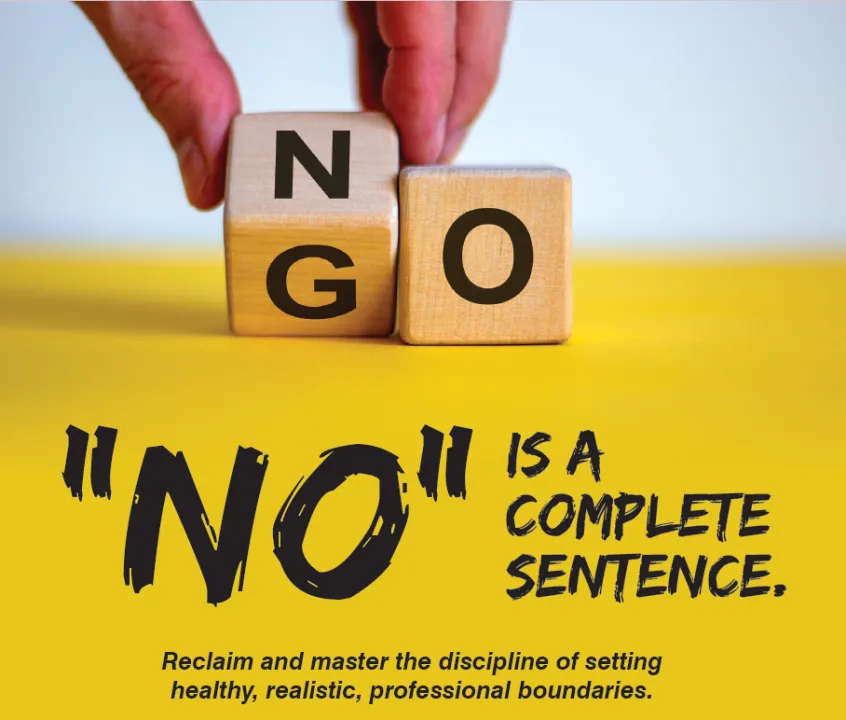
No is a complete sentence
Reclaim and master the discipline of setting healthy, realistic, professional boundaries.
How many times in the past week have you been asked how you are going and the answer you gave was the ubiquitous “busy” (often accompanied by an exasperated sigh). My guess is more than once, probably closer to three times, or four, or more. And when that same person asked you a follow-up question like “What are your top three priority tasks or projects right now?”, chances are you found it hard to give them any specifics off the top of your head.
After all, there is so much on our plates between work, family, social events, holidays, floods, unplanned leave due to a positive COVID-19 test … and the list goes on. As a result, our lives are one big blur of uncertainty, never-ending ‘To-do’ lists and demands. And while our “busy” answer may well be justified, the fact that we are unable to articulate our current priorities, clearly and succinctly, is a huge red flag.
Since the beginning of the year, LGMA has been engaged by three different councils to deliver in-house leadership development programmes and the Ignite Programme has been running in both Brisbane and Cairns. Each of these programmes is specifically tailored to assist emerging leaders and people managers to practise a suite of skills to increase the probability of successfully developing and leading high-performing teams in local government.
One of the reoccurring challenges expressed by participants across every one of the programmes has been the persistent sense of overwhelm that people are experiencing. When they look at the sheer volume of work to be delivered by local governments coupled with the extreme lack of people and time available within which to deliver said work, it becomes difficult to see the light at the end. Add to this, many hold a perception that, as officers, they are powerless to manage unrealistic expectations being ‘handed down from above’ which include adding new projects to the existing pressure to continue to deliver business as usual.
But is this perception accurate? A key factor contributing to our experience of stress and overwhelm is primarily driven by how we think about and evaluate our current capacity to cope with demands.
In her latest book Atlas of the Heart, world-renowned author and grounded theory researcher, Dr Brené Brown, talks about the difference between feeling stressed and being overwhelmed. Brown states that “chronic exposure to high levels of perceived stress have been shown to correlate with more rapid ageing, decreased immune function, greater inflammatory processes, less sleep and poor health behaviours.” She further explains that the times when we feel stressed are when our “thinking brain” evaluates that the current environmental demands on us are beyond our ability to cope successfully.
Relevant to our environment today, this includes elements of unpredictability, uncontrollability and feeling overloaded. Stressful situations can cause both physiological (body) and psychological (mind and emotion) reactions. In other words, we have an emotional response to stress because our thinking brain is saying, “I can’t handle this, it’s too much”.
Closely related to stress is overwhelm, which is defined as an extreme level of stress and emotional or cognitive intensity to the point of feeling unable to function. The key difference with overwhelm is that the ‘thinking brain’ has gone past all rational thought and is not capable of problem-solving in that moment.
Jon Kabat-Zinn, an American professor emeritus of medicine and the creator of the Stress Reduction Clinic at the University of Massachusetts Medical School describes overwhelm as the all-too-common feeling “that our lives are somehow unfolding faster than the human nervous system and psyche are able to manage well”.
Kabat-Zinn suggests that mindful play with no agenda or non-doing time is the cure for overwhelm. The key here is to give your brain time to think of ‘no-thing’ which helps the mind to snap out of the overwhelmed state and reset itself back to a resourceful state where the rational brain can come back online and reengage the problem-solving parts of the brain.
Another key factor that compounds stress and overwhelm is when we have a limiting belief that we are ‘not allowed to’ or ‘feel unable to’ say no to additional workload or push back against unrealistic expectations. This perceived sense of helplessness has the potential to become a dangerous driver toward burnout and resignation if not properly managed.
So how can you take back control and go from busy with overwhelm to buzzing with excitement? The answer is simple – learn how to say ‘no’.
Now we are not suggesting that you say no to everything, or that you say ‘no’ out of spite or laziness. What we are suggesting is that you say ‘no’ in order to appropriately manage expectations. ‘No, not now’ or ‘No, I don’t have any spare capacity right now, but I do have capacity next week’ can reduce problems down the track when delivery does not happen.
In order to say ‘no’ with integrity, we need to establish a clear and visible set of current priority tasks, without which it is difficult to justify (to ourselves and others) our reasons for saying ‘no’. Likewise, without a current priority task list, everyone else’s priorities will prevail. We say ‘yes’ without thinking or allow our email inbox to dictate our priorities and then next minute, we are drowning under the never-ending workload again, and we only have ourselves to blame.
The trap here is failing to explain what the implications of saying yes to a request are on other work we have. If we don’t explain the impact to our manager or colleagues, how will they (or any other person asking) know? They may not know how long the task will take, where your other tasks are currently sitting in terms of completion or what is coming in through customer inquiry lines etc. In giving you a task, they are likely missing lots of context which would be required to judge the priority of the task. Saying no and then explaining kicks off that important conversation to assess priority.
So, the next time someone asks you to redirect your energy from a current task to a different task (one that is not currently on your priority list), have a go at clearly and succinctly saying ‘No, that’s not a current priority right now – what would you like me to stop doing in order to start doing that for you right now?’. This is a powerful question that requires the other person to justify to you the merit of their request to adjust priorities.
In some cases, the re-prioritisation process will be warranted depending on the urgency, importance and stakeholders involved. In these instances, this discussion can become a good catalyst for resetting priorities and building common understanding across the team. If unwarranted, then the conversation becomes about when or if you have time in the future to assist with the task or project.
The beauty of this approach is that it starts a conversation which has a higher probability of delivering better-quality decision-making. Without the conversation, you are reduced to saying yes without contributing your assessment and forced to follow someone else’s assessment of ‘what the priority is’ without properly testing their logic against the team’s stated goals.
WARNING: Once you have had the conversation and agreed to reprioritise, make sure you also establish an agreed set of expectations for what the finished task looks like, including how you will know it is done (success measures), when it is due by and who else will need to be involved to help bring it to completion. At which time you will then have the joy of asking someone else to reprioritise their workload to help you with the task. And so, the cycle repeats.
Hopefully, when you practise this approach, you will be surprised at how few people question this approach. In fact, you will probably find that people respect you even more for setting and maintaining professional boundaries. You may also develop a reputation as someone who can be relied on to get things done in a balanced and measured way, with little- to no- stress or drama.
written by Fiona Cullen, when she was LGMA Programme Facilitator for the LGMA Journal - June 2022